Articles
, Founder and Chairman
Reusable cup hire can make switching from single-use simple. But repeated hire, loss and washing charges can add up. Learn what venues should consider.

Reusable cup hire has made it much easier for stadiums, arenas, festivals and other large venues to move away from single-use cups.
The model is simple. Rather than buying thousands of reusable cups, a venue rents them from a specialist provider. The provider can also take care of delivery, collection, washing and redistribution.
For a one-off event, seasonal festival or venue testing reuse for the first time, that can make a lot of sense.
But the economics start to look different when reusable cup hire becomes a permanent part of your operation.
If you run dozens of major events every year, you can end up paying to hire the same reusable assets again and again. On top of the headline hire price, there can be charges for lost cups, additional washing and other services.
There is another issue that is much less frequently discussed: how do you independently verify what you are being charged for?
For permanent, high-volume venues, it is worth looking beyond the headline price of reusable cup hire and asking what the scheme really costs over its lifetime.
What does reusable cup hire actually cost?
Reusable cup hire is usually sold as a managed service. The precise model varies between suppliers, but the cost can include cup rental, washing, logistics, collection and redistribution. Losses and additional services can create further costs.
That convenience is one of the main attractions of rental. A venue doesn't have to purchase a large cup fleet upfront or build all the operational infrastructure needed to support it.
It is also why comparing reusable cup hire purely on the advertised price per cup can be misleading.
We've been working with a large UK venue to understand the economics of its existing reusable cup rental scheme. The figures below have been adjusted to protect commercial confidentiality, but use the same underlying charging model.
The venue hires around 50,000 cups for a major event.
At 33p per cup, the basic hire cost is:
£16,500 per event.
Across 40 major events a year, that becomes:
£660,000 in annual cup hire.
But the hire charge is only the starting point.
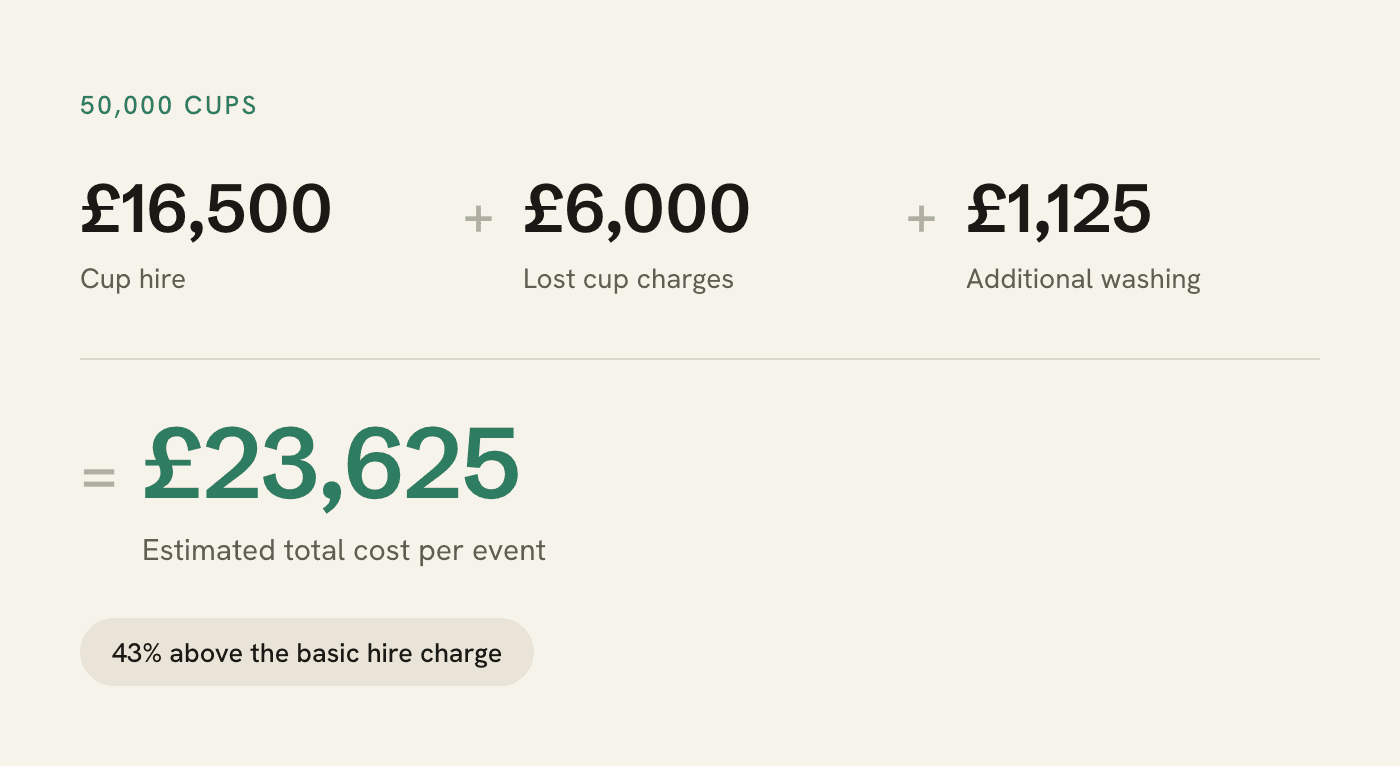
How a £16,500 reusable cup hire bill can become £23,625
Consider what happens when losses and additional washing are included.
Using an illustrative 20% loss rate, 10,000 of the 50,000 cups would be recorded as missing after an event.
At a replacement charge of 60p per cup, that adds:
£6,000.
If 15% of the cups require an additional wash and that is charged at 15p per cup, another:
£1,125 is added.
The total estimated cost of the event has now moved from a headline hire cost of £16,500 to £23,625.
That's 43% more than the basic hire charge.
Across 40 major events, the same assumptions produce an estimated annual cost of £945,000, of which £285,000 relates to lost cups and additional washing.
Cost | Per event | 40 events |
|---|---|---|
Cup hire | £16,500 | £660,000 |
Lost cup charges | £6,000 | £240,000 |
Additional washing | £1,125 | £45,000 |
Total | £23,625 | £945,000 |
The loss and additional-wash figures are illustrative. Actual performance will vary considerably between venues and events.
And that's precisely the point.
If a significant proportion of your final reusable cup bill is determined by what happens operationally, you need reliable data showing what actually happened.
If 10,000 cups are missing, how do you know they're missing?
Imagine receiving an invoice showing that 10,000 reusable cups have been lost.
At 60p each, that's a £6,000 charge.
Can you independently verify the number?
In a conventional outsourced reusable cup hire model, the supplier may provide the cups, manage their collection, wash them, count them and report how many have been lost.
The venue can therefore find itself relying on supplier data to determine the variable charges on the supplier's own invoice.
That doesn't mean the figures are wrong.
The question is whether a material operating cost should depend on figures the customer cannot independently verify.
The same issue applies to additional washing. If thousands of cups are charged for a second wash, does the venue have its own data against which to reconcile that charge?
At a small event, the sums involved may not warrant additional infrastructure. At a stadium, arena or other venue processing millions of cup uses over several years, relatively small differences can become significant.
If you can't independently measure your reusable cup system, it is very difficult to independently validate what it is costing you.
You don't have to replace your reusable cup hire scheme to get the data
There is a middle ground between accepting the existing model and replacing it completely.
Existing reusable cups can be retrofitted with RFID tags, giving each cup a unique digital identity. Large numbers of cups can then be scanned in bulk as they enter and leave a venue.
This allows the venue to keep its existing reusable cup hire supplier while creating its own independent record of cup movements.
And it can be introduced relatively quickly.
Rather than waiting for a contract renewal or changing the entire operating model, a venue can start building an independent dataset within weeks.
If 50,000 cups arrive before an event, that can be recorded. If a different number leaves afterwards, the venue has its own record. Those figures can then be reconciled against the supplier's reporting and any subsequent loss charges.
The same approach can be extended further through the operation.
A scanner at the washing facility can record cups arriving for wash and returning to circulation. That creates another independent data point against which washing volumes and charges can be checked.
This means better visibility doesn't require a venue to take everything in-house on day one.
It can start by answering a much simpler question:
Are we paying the right amount for the reuse scheme we already have?
With reusable cup hire, you keep paying for an asset you never own
There is a second question that permanent venues should consider.
A reusable cup is designed to be used repeatedly. That's where much of the environmental and financial benefit comes from.
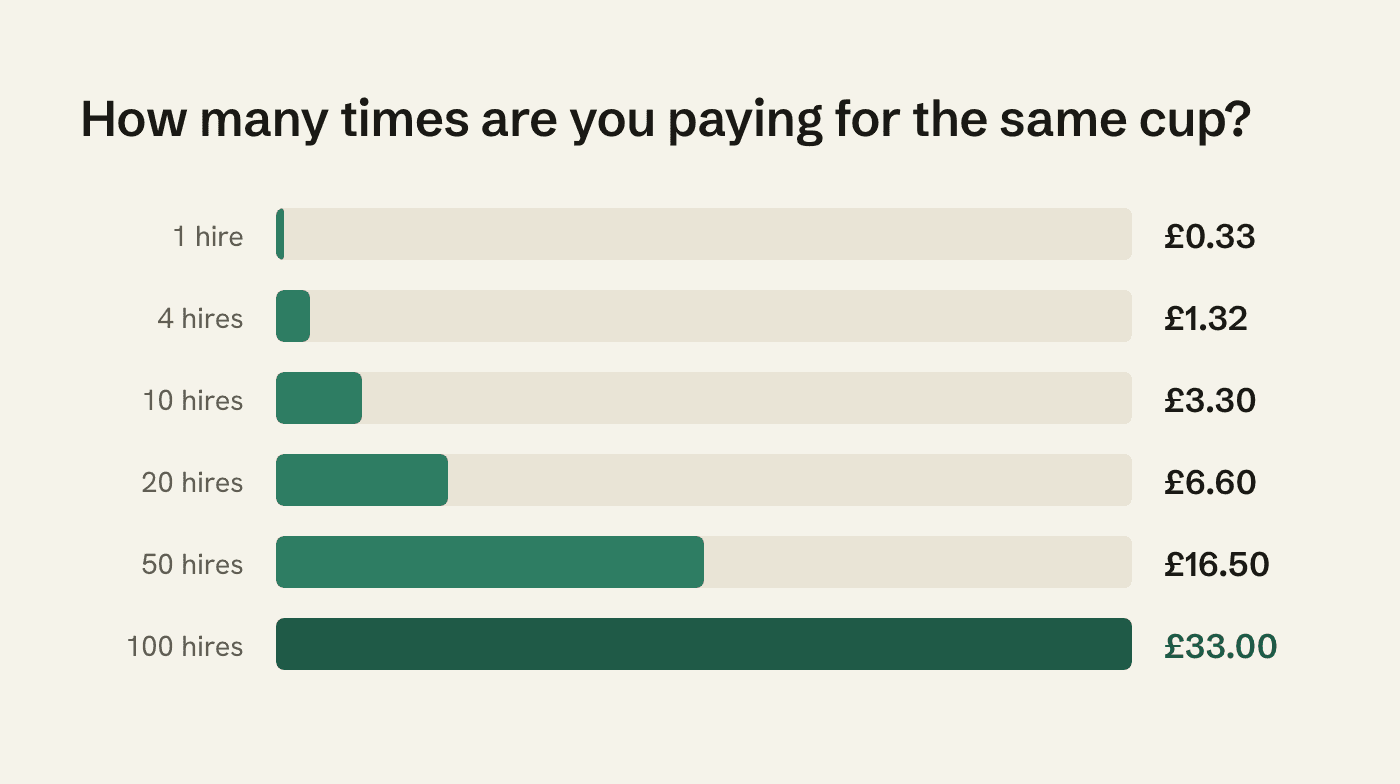
Yet under a rental model, the venue can continue paying a hire charge each time that same type of asset goes back into circulation.
At the 33p hire price in our example:
Number of hires | Cumulative hire cost |
|---|---|
1 | £0.33 |
4 | £1.32 |
10 | £3.30 |
20 | £6.60 |
50 | £16.50 |
100 | £33.00 |
That matters because reusable cups can have long operational lives.
The Financial Times reported in its coverage of the Eden Project's reusable cup programme that reusable cups typically reach cost parity with single-use alternatives after around 10 uses and can last for hundreds of commercial wash cycles. Eden estimated that it saved approximately £25,000 on single-use cup supplies in 2024.
Blenheim Palace provides another useful example.
Before introducing its reusable cup system, Blenheim was spending more than $100,000 annually on single-use cups. Its reusable cups cost approximately $2 each, and its calculations found that each cup needed only four uses to recover that initial cost compared with the $0.35 to $0.67 it had previously spent on each disposable cup.
By the second year, Blenheim reported a 50% reduction in beverage packaging costs, including savings from reduced waste management expenses and greater operational efficiency.
The important distinction is what happens after the initial cup investment has been recovered.
If you own the cup, you own an asset that can continue circulating.
If you hire it, the hire charge continues every time you need another cup for another event.
Does that mean reusable cup hire is a bad idea?
No.
Rental solves several genuine problems.
It avoids a significant upfront investment. It can remove the need to manage washing and logistics. It gives venues flexibility when demand is uncertain and makes it easier to trial a reusable cup scheme without committing to a permanent system.
For a festival operating for a few days each year, that can be a very sensible trade-off.
The calculation changes for a venue operating throughout the year.
A stadium hosting 40 major events isn't making a one-off decision to hire 50,000 cups. It is potentially purchasing two million individual cup hires every year.
Over three years, that's six million hires.
Over five years, ten million.
At that point, the question shouldn't simply be:
How much does reusable cup hire cost?
It is also worth asking:
What would the economics look like if we owned the cups instead?
Higher return rates can change the economics
Whether cups are hired or owned, keeping them in circulation is fundamental to making reuse work.
Every cup that isn't returned has to be recovered or replaced. For an owned system, that means replacing an asset. Under a rental model, it can mean paying the supplier's loss charge.
A deposit return scheme gives customers a clear reason to bring cups back.
The customer pays a deposit when taking the cup and receives it back when the cup is returned. The easier that return is, the more effective the system can become.
At Eden Project, fewer than half of reusable cups were being returned under its previous scheme. After introducing re-universe, which made returning a cup and receiving the deposit refund significantly easier, it reported a 96% return rate.
Blenheim Palace uses the same re-universe infrastructure to operate its own reusable cup scheme. Each cup has a digital identity, returns are recorded through the platform and customers receive near-instant deposit refunds back to their payment cards, without needing to download an app or provide additional banking information. At Blenheim, reverse vending machines provide the physical return points.
The return setup can therefore be designed around the venue. The underlying infrastructure remains the same: identify the reusable asset, record its journey through the system, manage the deposit and return, and give the operator visibility over what is happening.
For venues assessing reusable cup hire costs, return rate therefore belongs in the financial model.
Using our illustrative 50,000-cup event and a 60p loss charge, the impact is significant:
Return rate | Cups not returned | Illustrative loss charge |
|---|---|---|
80% | 10,000 | £6,000 |
90% | 5,000 | £3,000 |
95% | 2,500 | £1,500 |
96% | 2,000 | £1,200 |
Moving from an 80% return rate to 95% would reduce the illustrative loss charge from £6,000 to £1,500 per event.
Across 40 events, that's a difference of £180,000 a year.
The calculation is illustrative, but the principle matters. The cost of reusable cup hire isn't determined only by the supplier's price. The performance of the reuse system can have a substantial effect on what the venue ultimately pays.
A missing reusable cup isn't necessarily a lost cup
There is another part of cup loss that can easily be overlooked.
Some reusable cups inevitably end up in general waste.
At large venues, recovering those cups can mean staff physically searching through all waste bags for reusable assets. That's extremely labour-intensive, difficult to scale and still provides limited visibility over where losses are occurring.
RFID offers another way to approach the problem.
Because multiple tagged cups can be detected at once, waste bags can be scanned to identify whether reusable cups are inside and how many have been discarded.
Staff can then focus recovery efforts on bags known to contain cups rather than searching every bag.
That can reduce the number of cups ultimately written off as lost while giving the venue a clearer picture of where its inventory is going.
It also creates an important distinction:
Missing at the end of service doesn't necessarily mean lost.
Before paying to replace thousands of supposedly lost reusable cups, a venue should ideally know whether they have actually left the system.
From validating your hire costs to owning your reuse system
For a permanent venue, moving away from reusable cup hire doesn't have to happen overnight.
A more practical approach can be to introduce independent tracking first.
Retrofit existing hire cups with RFID tags. Scan inventory entering and leaving the venue. Add visibility at washing facilities. Track where losses are occurring. Improve return rates through a deposit scheme. Identify cups entering the waste stream.
The immediate objective doesn't need to be changing suppliers.
It is establishing an independent operational dataset.
Once a venue has that data, it can start answering questions that were previously difficult to resolve.
How many cups do we really use? What is our actual loss rate? How many additional washes take place? Where are cups being lost? What is our true cost per use?
That evidence can be used to validate existing supplier charges and improve the current scheme.
It also provides the information needed to decide whether ownership makes financial sense.
A venue might initially continue renting its entire fleet. It could subsequently purchase part of its inventory, bring certain functions in-house or eventually own the complete cup fleet while continuing to outsource washing and logistics.
Ownership can be a transition rather than a single decision.
And buying cups alone doesn't create an effective reuse system.
A venue still needs washing, storage, logistics, returns and a way of keeping cups circulating. Most importantly, it needs visibility.
This is how re-universe operates at Blenheim Palace. Each reusable cup has a digital identity and re-universe provides the infrastructure connecting the cup, its return and the customer's deposit. Blenheim owns its cups and manages their circulation, while re-universe provides the technology and data layer that makes the system measurable.
The physical infrastructure can vary from one venue to another. At Blenheim, customers return cups through reverse vending machines. Elsewhere, returns can be recorded through other scanning infrastructure. That flexibility allows the same re-universe platform to support different venue layouts and operating models.
That data has become an important part of how Blenheim operates the scheme. David Green, Head of Innovation at Blenheim Palace, told Harvard Business Review that the organisation now measures operational efficiency, visitor satisfaction and return rates by location, allowing it to continually refine the system.
Reusable cup hire vs ownership: which is right for your venue?
There isn't a universal answer.
For occasional events, rental can offer exactly what is needed: access to reusable cups without the upfront investment or operational responsibility of owning them.
For permanent venues, the decision deserves a more detailed financial comparison.
A stadium, arena, visitor attraction, university or other high-volume venue should look at the total cost over several years, rather than simply the price of the next event.
That calculation should include the cost of purchasing the cup fleet, expected lifespan, washing, logistics, storage, expected losses, technology and operational support.
Then compare it with the full cost of reusable cup rental over the same period, including loss and additional service charges.
The higher the number of reuse cycles, the more important that comparison becomes.
Before renewing your reusable cup hire contract, ask these questions
If your organisation already hires reusable cups, there are a few numbers worth understanding:
What is our total annual cost, including charges beyond basic cup hire?
How many individual cup hires are we paying for each year?
What are we charged when a cup is reported lost?
How is that loss figure calculated, and can we independently verify it?
Are there additional washing or handling charges, and how are they validated?
What is our actual return rate?
How many supposedly lost cups are entering our waste stream?
What would it cost to purchase the cup fleet instead?
How many uses would it take to recover that investment?
Could we own the cups while continuing to outsource washing or logistics?
Do we have our own data showing where our reusable assets are and how they're performing?
For venues running reuse at scale, the answers can reveal a very different picture from the headline rental price.
Start with visibility
The first phase of reuse has understandably focused on replacing disposable cups.
For venues already operating reusable cup hire schemes at scale, the next challenge is making sure those systems work operationally and economically.
That doesn't mean replacing an existing supplier tomorrow.
Start with visibility.
Can you independently establish how many cups enter and leave your venue? Can you validate reported losses? Can you see how many cups reach the washing facility? Can you identify reusable cups entering your waste stream? Do you know your actual return rate? And can you understand the true cost of every reuse cycle?
Once you have that data, you can improve the economics of the scheme you already have and make a much better-informed decision about what to own in the future.
The same re-universe infrastructure can support different reuse models.
At Eden Project, re-universe helped make returns significantly easier, contributing to an increase in cup return rates from below 50% to 96%.
At Blenheim Palace, the platform supports an owned reusable cup system that has helped halve beverage packaging costs. Each cup has a digital identity, customers receive near-instant deposit refunds and Blenheim has the data to understand how the scheme is performing.
The return mechanism can be different. The principle is the same: give every reusable asset an identity, make returning it easy, connect the deposit to the return and give the operator visibility over the whole system.
For occasional events, fully managed reusable cup hire may remain the right answer.
For permanent venues processing hundreds of thousands or millions of cups a year, there is another route: start by owning the data, then use that evidence to decide how much of the reuse system you should own.
Want to understand what your reusable cup hire scheme is really costing?
re-universe can add independent tracking to an existing reusable cup scheme without requiring a venue to replace its current supplier.
By adding digital identities to reusable cups and tracking them through the venue, return process and wash cycle, operators can start validating losses, washing volumes and inventory movements before deciding whether to bring more of the system in-house.
