Research & Guides
, Chief Marketing Officer
A real-world Dublin trial tested whether people would use a digital deposit return system through household recycling, with a reported 94% return rate.
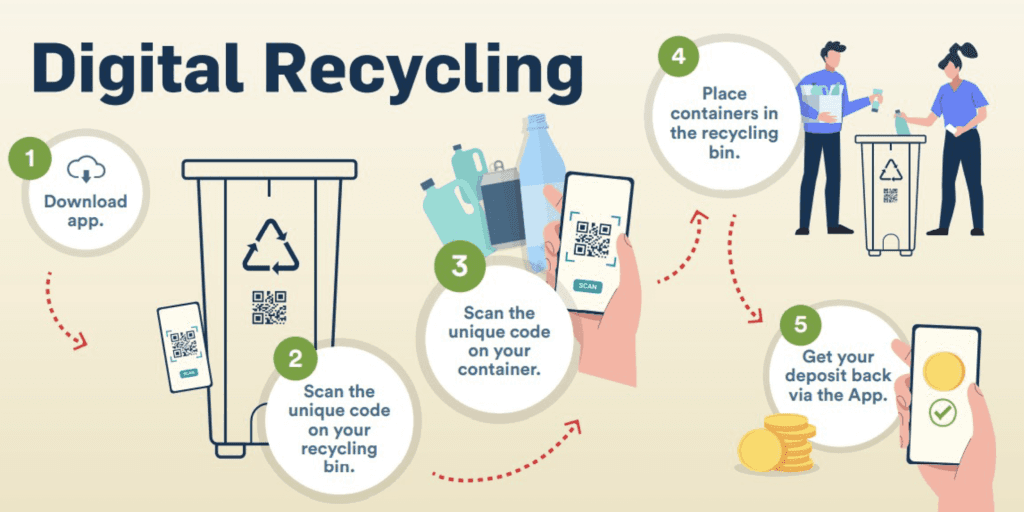
In 2021, the Irish Waste Management Association (IWMA), Panda and CryptoCycle conducted a trial of a Digital Deposit Return Scheme (Digital DRS) using households from Panda’s waste collection service in Dublin.
The trial built on earlier Digital DRS testing in Whitehead, Northern Ireland. A key difference in Dublin was that participants paid a genuine deposit on the items they received and redeemed that deposit when placing the empty packaging into their household recycling. The trial also tracked containers from delivery to the consumer, through collection and on to a sorting facility.
The trial reported a 94% return rate, with 655 containers deposited using the Reward4Waste app from 700 eligible containers delivered to participating households.
What was the trial designed to test?
The Dublin trial was designed to build on the earlier Whitehead proof of concept in two specific ways:
testing consumer behaviour when an actual deposit and refund were involved
tracking packaging from delivery through household recycling and back to a Materials Recovery Facility (MRF)
The aim was to test whether an app-based Digital DRS could enable consumers to redeem deposits while continuing to use their existing household recycling infrastructure.
The project also sought to investigate an important question for a digital deposit system: after redeeming a deposit, would consumers actually place the corresponding container into the recycling system?
How the trial worked
The trial was offered to selected customers on Panda’s domestic waste collection service in South Dublin.
Participants signed up to the scheme, installed the Reward4Waste app on their smartphones and labelled their household recycling bin with a compatible unique code. They could then order coded milk packaging through a dedicated delivery service.
Milk was deliberately chosen because it is perishable and fast-moving, creating a relatively short period between delivery, consumption and disposal. The trial used one-litre milk packaging across full-fat, low-fat and skimmed milk.
Milk was delivered twice a week over a four-week period. Each coded container was scanned during delivery and linked to the household receiving it, allowing the trial team to analyse behaviour at an individual customer and container level.
Customers were charged 75c per litre of milk plus a 25c deposit for every container delivered. The cost was added to their Panda services bill.
After consuming the milk, participants used the app to scan the code associated with their recycling bin and the unique code on the empty container. The redeemed deposit was then shown on the customer’s subsequent Panda invoice.
The container could then remain within the household recycling system rather than being taken back to a retailer.
Consumer participation
234 Panda customers agreed to participate and were issued with a trial welcome pack.
Of these:
146 customers installed the Reward4Waste Dublin app, scanned their bin code and registered for a deposit return account
122 customers ordered milk during the trial
participating households ordered an average of seven litres of milk during the four-week period
The highest-volume participating household ordered 35 litres over the course of the trial.
A reported 94% return rate
The overall dataset initially recorded 752 containers delivered and 655 deposits redeemed through the app.
The report then removed a small number of containers from the analysis where there was evidence that customers had not actually received the milk delivery. The report documents these exclusions as part of its data-cleaning methodology.
After those exclusions, the final dataset contained:
700 containers delivered
655 containers deposited using the app
94% reported return rate
The trial therefore provided evidence that participating consumers were willing to engage with a genuine deposit and refund mechanism while using their existing household recycling service.
Following the containers into the recycling system
The trial went beyond measuring digital deposit redemptions.
Panda separately collected recycling bins from participating households and took the material to its MRF in Ballymount. The material was then manually sorted to recover coded trial containers and investigate whether containers for which deposits had been redeemed were actually entering the household recycling stream.
Panda’s recycling bins already contained RFID chips that identified individual customer bins as they were emptied into collection vehicles. This allowed information from Panda’s collection system to be compared with data generated by the Reward4Waste app.
The hand-sorting exercise involved approximately 1,200kg of mixed household recycling.
Some containers had to be excluded from the physical-recovery analysis because the relevant household bin had not been presented for collection or had not been included in the material that was manually sorted.
After these exclusions, 572 deposited containers could reasonably have been expected to be available within the material being hand-sorted.
Of these, 492 were physically recovered, representing an 86% recovery rate within the manual sorting exercise.
This 86% figure should not be interpreted as the trial’s recycling or deposit-return rate.
The report explains that manually recovering individual coded containers from mixed, compacted household recycling was extremely difficult. Containers could be crushed, damaged, placed inside other packaging or simply missed during manual sorting. The authors therefore considered the physical-recovery exercise to broadly support the conclusion that consumers were placing containers into household recycling after redeeming their deposits.
What did the Dublin trial demonstrate?
The Dublin project was a limited real-world trial rather than a full-scale national deposit return scheme.
Within that scope, it demonstrated that participating consumers could pay a genuine deposit, digitally redeem it and continue using household recycling rather than having to return the packaging to a retailer.
It also demonstrated how individually coded packaging, app data and existing waste-collection information could be combined to follow containers through several stages of the recycling journey.
The headline result was a reported 94% return rate, based on 655 deposited containers from 700 eligible delivered containers after the exclusions described in the report.
From Reward4Waste to re-universe
The technology used for the Dublin trial was called Reward4Waste and was developed by CryptoCycle.
Today, the business operates as re-universe. Reward4Waste was the former name of the platform and CryptoCycle was the founding company.
The technology and commercial proposition have evolved since this 2021 trial. The Dublin project is therefore best understood as an early trial in the development of the technology that preceded today’s re-universe platform.
Its continuing relevance is the principle it tested: digital infrastructure can connect individual packaging items, consumers, deposits and existing collection systems while allowing returns to happen through infrastructure people already use.
